
After the overwhelming reception, we decided it will be a shame to leave the project as it is.
We are currently planning to develop the documentary into a series and as an opportunity arises attempt to cover further gigs/provide interviews to acquaint people better with the Scottish DIY music scene.
As of now we are not exactly sure how many episodes/documentaries there will be, however we are planning to swing our cameras around in Glasgow by the end of June and produce the subsequent part two.
Keep your fingers crossed!

The final product/ Reception
All corrected, it was ready to go.
We released two versions, one which had the original colors and the other with colour corrections.
Original
The same except colour corrections.
This, to compare is Jamie's final product, the 20 min long documentary:
Again the critical reception was much more than we hoped for: the trailers were viewed over 700 times whereas the final movie (which was featured on several websites) has scored a total of 1400 views (as of 10/05/12).
Review 1
Review 2
We released two versions, one which had the original colors and the other with colour corrections.
Original
The same except colour corrections.
This, to compare is Jamie's final product, the 20 min long documentary:
Again the critical reception was much more than we hoped for: the trailers were viewed over 700 times whereas the final movie (which was featured on several websites) has scored a total of 1400 views (as of 10/05/12).
Review 1
Review 2
Development: trailer part3: the missing something.
As agreed before we opened with the Cleavers' 'phewwww' but with voice alone. I moved the opening titles a bit and featured myself. In this way the voice over sequence was of good length and I did not have to adjust anything.
The font was corrected so it matched the one used in Jamie's documentary (which was ready to go by then).
I added the final sequence which introduces every band which performed. It still was missing the SUFFERINFUCK, as I had no footage of them playing, only the inteviews.
There were two ways to on this: one I could choose a bit from Jamie's footage, and two I could just proceed with the interview bit. Since the standard definition of Jamie's camera looks completely different in therms of quality plus it was a fixed position camera, we decided it's best to preserve the continuity and use the existing interview footage.
This time again I used the music of one of the performers (Billy Liar) so again it got closer to what one would expect in the actual documentary.
This version has the corrected font, and the logo, all it was missing was minor sound corrections and re-adjusting the fade to blacks as sometimes when clip 1 was fading to black, clip 2 was visible for a split-second. I also had to re-adjust the timing of the intro screens etc.
All to be sorted out for the final release.
The font was corrected so it matched the one used in Jamie's documentary (which was ready to go by then).
I added the final sequence which introduces every band which performed. It still was missing the SUFFERINFUCK, as I had no footage of them playing, only the inteviews.
There were two ways to on this: one I could choose a bit from Jamie's footage, and two I could just proceed with the interview bit. Since the standard definition of Jamie's camera looks completely different in therms of quality plus it was a fixed position camera, we decided it's best to preserve the continuity and use the existing interview footage.
This time again I used the music of one of the performers (Billy Liar) so again it got closer to what one would expect in the actual documentary.
This version has the corrected font, and the logo, all it was missing was minor sound corrections and re-adjusting the fade to blacks as sometimes when clip 1 was fading to black, clip 2 was visible for a split-second. I also had to re-adjust the timing of the intro screens etc.
All to be sorted out for the final release.
Development: second edit: dialogues, more bits
The second edit is where the background music faded away and I used more interview parts and general dialogues. The sequence features a fast-paced mixture of the live-music bits,
Despite using the rather 'soft' Beastie Boys song I included some examples of what the bands really sound like (in the 'simple reef' section).
Jamie liked this version except for the opening sequence as it features one of the bands which was not covered live, so he asked me to remove it.
As the sequence was catchy and gave briefly what the clip is all about I decided to still keep it but without showing the performers, so as to keep the continuity.
According to Jamie this was nearly ready to go other than cleaning up the dialogues a bit (fade ins and outs).
To me it was still missing something. More on that in the next post.
Despite using the rather 'soft' Beastie Boys song I included some examples of what the bands really sound like (in the 'simple reef' section).
Jamie liked this version except for the opening sequence as it features one of the bands which was not covered live, so he asked me to remove it.
As the sequence was catchy and gave briefly what the clip is all about I decided to still keep it but without showing the performers, so as to keep the continuity.
According to Jamie this was nearly ready to go other than cleaning up the dialogues a bit (fade ins and outs).
To me it was still missing something. More on that in the next post.
Development: the first edit - why.
Going back to the research on punk philosophy the word that I came across most often was individuality and how crucial for the punks it is to emphasise it via all the means possible ranging from controversial political views to even more striking clothing style.
My first step was to showcase this range of individualism among the audience and the performers alike. This was pretty easy to pin-point as the performers ranged in the genres of the specific music. Some would wear military, some would wear leather, the haircuts ranged in anything from dreadlocks to long hair as well as some of bald-heads. And of course I had to throw in the classic symbol: a mohawk.
This was the first bit I produced which I showed Jamie.
My first step was to showcase this range of individualism among the audience and the performers alike. This was pretty easy to pin-point as the performers ranged in the genres of the specific music. Some would wear military, some would wear leather, the haircuts ranged in anything from dreadlocks to long hair as well as some of bald-heads. And of course I had to throw in the classic symbol: a mohawk.
This was the first bit I produced which I showed Jamie.
Development: trailer music.
As said the choice in music was crucial.
Not only it had to be a track relatively 'easy' to listen, but also the band should have a proper status (the use of bands such as Offspring, Green Day etc. would not be appropriate due to their commercial status and the fact that according to many punk performers they are too mainstream/pop to be considered true punk).
After browsing my music library , spotify and youtube I decided to pick Beastie Boys' Egg Raid on Mojo.
Beastie boys despite their commercial success maintain a respectable reputation and are quoted to draw inspiration from the Clash, one of the bands thought to be initiators of the punk movement.
As such I was sure that the music choice would not be pretentious.
The song also meet my image of fast paced sequence of the trailer with the intro reefs
Next: the first steps of the trailer.
Not only it had to be a track relatively 'easy' to listen, but also the band should have a proper status (the use of bands such as Offspring, Green Day etc. would not be appropriate due to their commercial status and the fact that according to many punk performers they are too mainstream/pop to be considered true punk).
After browsing my music library , spotify and youtube I decided to pick Beastie Boys' Egg Raid on Mojo.
Beastie boys despite their commercial success maintain a respectable reputation and are quoted to draw inspiration from the Clash, one of the bands thought to be initiators of the punk movement.
As such I was sure that the music choice would not be pretentious.
The song also meet my image of fast paced sequence of the trailer with the intro reefs
Next: the first steps of the trailer.
Research: the trailer
The purpose of the trailer is to capture as big audience as possible, as I got out of working on the research for my previous project.
The difficulty I had for this project was how to expand target audience for such specific music.
On my subjective opinion, I could guess that this sort of music would not be appealing to an everyday music listener
As such I decided to browse the footage for the bits that sounded 'less hardcore' as well as pick some punk tracks which would be appropriate for the genre.
At the same time, I was pointing out the crucial dialogue bits for the purpose of the trailer.


Research: get to know the band
As I worked on the trailer, I decide to explore the bands whose performances we would make available.
In the order of appearance (I think):
1. Drug Couple
http://drugcouple.bandcamp.com/album/drug-couple
2. Fifteen Dead
(from their description on facebook page)
The idea for Fifteen Dead came about around early 2010. Whenever founding members Ross and Jamie were a few drinks down they'd talk about the concept behind it. What they wanted was to slam Crust Punk and Black Metal together to create something new and unique. After about half a year of forgetting all about it come the hangover, they actually got together and came up with the first Fifteen Dead song entitled "This is Scotland" in December 2010.
A few weeks later and the lineup was completed by Chris Bowers (drums), Alby Brew (bass) and Ryan "Badger" Watson (vocals). This lineup went on to record the Fifteen Dead Demo in Feb 2011. This rushed recording gathered the band a lot of interest at home and abroad and a UK and Irish tour being booked for the summer.
The band then sadly lost both Alby and Chris due to family and work commitments around March time. Two brilliant musicians stepped in however, Jason Rees (drums) and Paul "Fatboy" Shand (bass). This lineup can be heard on the bands DiY Gig Live Recordings release.
The next NecroCrust EP was released in August 2011. This was recorded in Jason's home studio with him behind the desk. This includes three new tracks that show how our sound has developed and the direction we're heading in.
Another three track EP is planned to be released by the end of the year after the October UK tour. Keep checking back for updates, we'll hopefully fire up some live recordings and re-recordings of a couple of demo songs soon!
NecroCrust!
- Ross Necro (August 2011)
The band then sadly lost both Alby and Chris due to family and work commitments around March time. Two brilliant musicians stepped in however, Jason Rees (drums) and Paul "Fatboy" Shand (bass). This lineup can be heard on the bands DiY Gig Live Recordings release.
The next NecroCrust EP was released in August 2011. This was recorded in Jason's home studio with him behind the desk. This includes three new tracks that show how our sound has developed and the direction we're heading in.
Another three track EP is planned to be released by the end of the year after the October UK tour. Keep checking back for updates, we'll hopefully fire up some live recordings and re-recordings of a couple of demo songs soon!
NecroCrust!
- Ross Necro (August 2011)
3. Clocked Out.
http://clockedout.co.uk/
4. Billy Liar
(from myspace.com profile)
Acoustic punk poet, Billy Liar, released second EP ‘It Starts Here’ on April 3rd. Produced by legendary American musician Acey Slade (Trashlight Vision/Murderdolls) the record also features Robin Guy (Faith No More/Bruce Dickinson/Rachel Stamp) on drums and Nick Mailing (The Smoking Hearts/Quireboys) on bass. Nick also undertook the position of studio engineer for these sessions.
Recorded in a studio on the outskirts of London ‘It Starts Here’ looks set to further enhance the popularity of the Glasgow based singer/songwriter. He’s already built himself a stunning legacy courtesy of his 2007 debut EP which received extensive radio airplay, with the song ‘Come Back To Edinburgh’ becoming a particular favourite with both the media and public alike. His profile within the music business, especially on the live circuit, has escalated quite remarkably. His own style of acoustic driven punk poetry depicts snapshots of sensitivity, love, desperation and frustration on the streets. It is this unpretentious and honest songwriting that has captured the imagination of an ever-increasing fan base.
The new EP offers much of the same honesty and integrity – with the added bonus of the aforementioned majesties of their professions making up the rest of the band. Billy Liar will be touring in support of the new record. For dates and locations, and any further info, visitwww.myspace.com/billyliarmusic
5. SUFFERINFUCK
(from myspace.com profile)
Development: getting more out of it
So initially for me the job was done.
I helped out with the footage, Jamie was working on editing the documentary. Happy ending.
I decided that there was more I could do with it so I have some output for my own assessment rather than just being credited.
My thought was that by using my footage alone I could produce a trailer for Jamie's documentary.
This covered with my aims as well: in this semester I have been trying to explore different video formats and techniques (promotional video, trailers, teaser, documentaries etc.).
More on it soon.

I helped out with the footage, Jamie was working on editing the documentary. Happy ending.
I decided that there was more I could do with it so I have some output for my own assessment rather than just being credited.
My thought was that by using my footage alone I could produce a trailer for Jamie's documentary.
This covered with my aims as well: in this semester I have been trying to explore different video formats and techniques (promotional video, trailers, teaser, documentaries etc.).
More on it soon.

Development: basic edits
Due to the low capacity of my Compact Flash memory cards, I had to split the footage into two separate compositions.
The event opened with Jamie interviewing the bands from a static angle whereas I took the extra footage 'walking about a bit'.
After the interviews were done we proceeded to the live performances.
As it turned out one of Jamie's camera was not working so I had to focus on the bands more as well (as opposed to the initial concept where I was supposed to film mostly whatever is not happening on the scene).
This was actually to our benefit, as the high definition footage from my DSLR was of much higher quality. If I was to capture only the background details we would miss a lot of close-ups of the bands etc.
I had a rough look on the footage I took and composed these two 'best-bits' compositions for Jamie to reference in his documentary.
The event opened with Jamie interviewing the bands from a static angle whereas I took the extra footage 'walking about a bit'.
After the interviews were done we proceeded to the live performances.
As it turned out one of Jamie's camera was not working so I had to focus on the bands more as well (as opposed to the initial concept where I was supposed to film mostly whatever is not happening on the scene).
This was actually to our benefit, as the high definition footage from my DSLR was of much higher quality. If I was to capture only the background details we would miss a lot of close-ups of the bands etc.
I had a rough look on the footage I took and composed these two 'best-bits' compositions for Jamie to reference in his documentary.
Development: sound
As in normal conditions one is limited to pick either external lamp or a microphone on the DSLR at one time, I decided to go with the lamp.
The decision turned out to be an accidental success: by omitting high quality sound I managed to fit more into the DIY atmosphere - the built in camera-mic is poor quality compared to just about anything else. The 'punk scene' is DIY again: poor equipment creates noise and sound distortions, we deliver the message across without even being aware of it.
Research: technical preparation
I browsed the punk theme thoroughly to get acquainted better with the topic, the technical side was also important
From the
technical point of view, I had to equip an Aladino lamp assuming the place will
not be lit too well.
Live-music
events tend to rely on the visuals and the lighting to a great extent and in
order for these to work, the room has to be almost dark.
I was given
a mock-up shot list which was meant to give me an idea of what I am actually
shooting. The list included mainly close-ups, object details etc.
There was no
specific plan as of the order of the band etc.
Research: video examples
Majority of 1970s music videos were actual band footage rather than directed short movies, it is easier to establish a sense of 'what is was like'.
Below:The Clash Guns of brixton and Rock the Casbah.
Key symbols/elements/icons:
Dirty
walls, leather jackets, alcohol, cigarettes, city, urban landscape, street,
live music, more alcohol
Sex Pistols
– God Save the queen and Anarchy in the UK
Explosions,
war, fire, controversial clothing style normally not accepted by an average
individual. Scenes featuring policemen as a general 'anarchy' theme popular
among the punk
Riot scenes.
Clothing/style:
boots, leather jackets, combat/military trousers/jeans, custom clothing style:
cut/thorn jeans, spiked leather, mohawks, sometimes colorful t-shirts (tie-dye)
Research: punk art/graphics
Punk in
graphic design.
"The counter culture of the 1960s was vital
to the development of British graphic design," Shaughnessy believes.
"Not stylistically, perhaps, but in showing how imagery could be used for
subversive or transgressive purposes. I think it showed that 'graphic design'
could be art, and made to deliver messages and codes. It was the first time
that graphic design departed from the old British tradition of good taste and
good manners."
Along with
the rise of the punk scene, not only a new music genre has been developed.
Punk was
famous for its DIY visual style which combined a variety of media through a
collage method. Graphics of this sort would combine photocopying with stencil
work and a font mixture, referred to as ‘anonymous’ later on. Another style
associated with the punk music was the ‘grunge’ – dirty, torn up graphics.

God Save the
queen, one of the most iconic images of the punk culture featuring the ‘anonymous’
font.
A fine
example of the DIY sense to punk was the Sniffin Glue magazine

Punk
movement had equally significant visual style associated with it. As it was
introduced in the mid 60s, which was a thriving period for various
post-modernist graphic styles it drew inspiration from many significant visual
movements.
The rich and
striking colour combinations typical for the psychedelic art were present in
majority of 60s works.

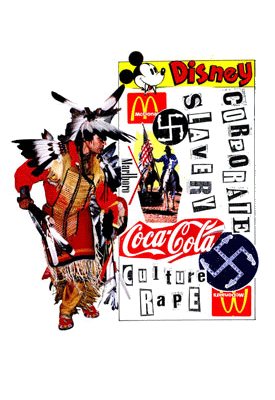
To a great extent, the art of punk is associated with Jamie Reid. Reid was to graphic design exactly what punk movement was to music/society.
"Although Reid is known primarily for the deployment of Situationist strategies in his iconic work for the Sex Pistols and Suburban Press, the manifold strands of his art both continue that work whilst showing us other ways in which we can mobilise our energy and spirituality. It is this dialectic between gnosticism and dissent that lies at the heart of Reid's practice and makes him one of the great English iconoclastic artists."
Further works of Jamie Reid:

Research: punk sub-genres
Again
followed from about.com.
This article
gave me a better insight on how difficult it is to classify punk alone as a
movement (then, many genres I came across during the gig are not even covered
here, so the list of DIY as such continues).
Pop Punk
More melodic
than hardcore, pop punk is a style that owes more to the Beatles and '60s pop
than other subgenres of punk. While the sound began with the Buzzcocks, it was
several years before it grew into what is arguably the most popular subgenre of
punk today.
Pop punk's
revival can be traced to 1988, with the establishment of Lookout! Records.
Based in California, the label was releasing music that went against the
California hardcore punk that was predominant on the scene at the time.
With bands
like Screeching Weasel and some young kids by the name of Green Day, the label
was systematically producing and releasing pop punk records. Like pop music,
the sound was infectious.
In 1994,
Green Day's album Dookie became a huge commercial success, and other
pop punk bands like the Offspring and NOFX quickly followed suit. Pop punk
bands continue to consistently climb the charts, and pop punk continues to be
the most commercially successful type of punk rock.
Essential
Bands: Buzzcocks, Green Day, Screeching Weasel, Offspring, NOFX, The
Descendents, blink-182, New Found Glory, Sum 41
Psychobilly
Psychobilly
is a blend of '50s rockabilly music and punk rock. It steals its name from a lyric
in Johnny Cash's "One Piece at a Time", where he sings about a
"psychobilly Cadillac".
Psychobilly
owes a lot to '50s culture as well. Predominant themes are the themes that were
considered underground in the '50s. This includes science fiction and horror
films. Bands often play upright bass and vintage organs rather than modern
instruments. People in the psychobilly scene often dress in '50s fashions as
well.
Essential
Bands: The Cramps, Hillbilly Hellcats, The Reverend Horton Heat
Riot Grrrl
Riot grrrl
was a relatively short-lived but very important punk rock movement. As a scene
it encompassed not only bands and music, but printed zines and punk culture as
well.
A
politically-motivated movement, riot grrrl had an agenda that covered feminism
as whole, focusing on gender equality in the punk scene. The lyrics of the
bands also addressed other charged issues, including domestic violence and
rape.
The
stronghold of riot grrrl culture was in Washington, where all-female bands like
Bikini Kill and Bratmobile were demanding to be noticed. Huggy Bear brought the
scene to the UK.
While it has
essentially died out, riot grrrl's messages live on. Today, the punk scene is
less male-dominated and more aware of women's issues.
Essential
Bands: Bikini Kill, Bratmobile, Heavens to Betsy, Huggy Bear
Ska Punk
Many of the
London neighborhoods where punk became popular with were heavily integrated
with a large Jamaican population. This lead to the creation of ska punk. Ska
punk blends the rhythms of Jamaican ska with the heavier beats of punk. It's
similar to traditional ska, but faster and heavier. Horn sections are common in
ska bands as well.
Many early
punk bands, most notably the Clash, experimented with ska and reggae beats at
some point in their careers. They didn't make it the foundation of their sound
like many American ska punk bands would in the late '80s and early '90s, when
the scene really began to grow.
Essential
Bands: Operation Ivy, Citizen Fish, Less Than Jake, The Mighty Mighty
Bosstones
Street Punk
Also known
as Oi, the street punk movement started in the late '70s. Directed toward the
working class and inner-city residents, it was intended as a direct reaction to
the first wave of punk bands. The first street punks felt that those bands and
their fans were pampered members of the upper middle class and that their music
didn't speak to the blue-collar punk.
Street punk
is like the Gangsta Rap of punk music. Its sound is often harsh; early street
punk lyrics dealt with poverty and police brutality. Another predominant theme
in street punk music is promoting unity among the working class. Today,
partying and social issues are just as likely to enter into the picture.
A large
portion of the working class punk scene was and is composed of skinheads. At
the same time the street punk scene was starting, racist organizations such as
the National Front were also recruiting skinheads. This gave rise to
misconception that street punk was overly racist. In fact, most street punk
bands have reacted by crying out against racism.
Essential Bands: Cock Sparrer, Exploited,
Swingin' Utters, The Cockney Rejects
Research: the punk history
(from about.com)
Whether or
not they intended to, and even when they had no idea they were doing so, many
punk bands have created music and caused events that would shape the face of
music. Here are some of the more important events.
1964-1969: It's All About Detroit (And A Little Bit About
New York)
In the mid
to late '60s, Detroit and New York were laying the groundwork for punk rock
with the formation of the MC5 and The Stooges in Detroit, and the Velvet
Underground in New York. The Velvet Underground and Nico was released
in 1967 and The Stooges' self-titled album and the MC5's Kick Out the
Jamsboth hit the streets in 1969.
The three
bands combined supplied future punk musicians with a mix of experimental noise
and explosive passionate rock. This is what the first punk bands would build
on.
1971: The New York Dolls Hit the Scene
1971 is the
year that a rock band named Actress hooked up with a new singer named David
Johansen, and they formed the New York Dolls. A blend of trashy glam rock and
high-energy noise, they begin to catch everyone's attention.
They would
eventually become Malcolm McClaren's first project. Years later, David Johansen
will become better known as Buster Poindexter.
1972: The Strand
A few guys
get together and begin playing together under the name of the Strand. They are
pretty unremarkable, but two of the members, Paul Cook and Steve Jones, would
go on to become half of the Sex Pistols.
1974: The New York Punk Scene Takes Off
1974 is the
year that The Ramones, Blondie and the Talking Heads appeared on the New
York Scene, playing in classic punk clubs like CBGB and Max's Kansas City.
1975: The Sex Pistols Play Out
The Sex
Pistols make their first live appearance, and people are interested. They
quickly take off from there. The band they open for is called Bazooka Joe.
Bazooka Joe will fade away, but one of their members, Stuart Goddard, will go
on to become Adam Ant.
1976: The Sex Pistols Spark the London Movement
A group of
young punks inspired by the Sex Pistols will decide to start their own bands,
and 1975 will see punk rock explode in London. Some of the bands that are
forming up in this year are punk pioneers like The Buzzcocks, The
Clash, The Slits, The Dead Boys, The Damned, The Jam, Siouxsie and the
Banshees and X-Ray Spex.
The Sex
Pistols launched their first tour, with The Clash and The Damned. The Anarchy
Tour will be be ill-fated; most clubs, fearing violence, will cancel the tour
dates.
1977-1979: The Appearance of American Hardcore
Inspired by
the British Punk Scene, American hardcore punk bands will emerge. In a
relatively short amount of time The Misfits, Black Flag, Bad Brains, The Dead
Kennedys and a score of other American punk bands will make their debut.
This same
span also covers the entire career of one of the most notorious figures in punk
history. In 1977, Sid Vicious joined the Sex Pistols. By the end of 1978, the
Sex Pistols had dissolved, and Sid Vicious was found dead from a heroin
overdose in New York on February 1, 1979.
1980: American Hardcore's First Peak and Decline
1980 is the
year that Penelope Spheeris made and released The Decline of Western
Civilization, a documentary on American hardcore, featuring performance and
interviews with Black Flag, Fear, The Circle Jerks and The Germs.
This was
also the year that Darby Crash of the Germs would commit suicide on December 8,
1980, the day before John Lennon was killed. While Crash's death wasn't a
direct factor, American Hardcore would begin to wane in popularity as the new
tide of bands hit the scene.
The 1980s: '80s Pop Blurs the Boundaries
In the '80s,
alternative music and '80s pop became the next wave of music. New wave and
postpunk bands became the craze, and punk would take the back seat for a while.
Punk bands
did continue to thrive on a smaller scale, though, and the '80s would still
allow for several important bands to start their careers. In 1984, the
appearance of NOFX, as well as the Offspring in 1985, signaled the beginning of
a boom in pop punk.
While
hardcore moved along a bit with Henry Rollins joining Black Flag in 1981 and
the appearance of the Vandals in 1982, the face of punk was definitely
changing. Mick Jones was kicked out of the Clash in 1983, and the Clash and
Black Flag would both break up in 1986. There was a definite new class of bands
moving in.
By 1988,
American Hardcore was fading rapidly. It's salvation came with the formation of
Epitaph records. Epitaph provided a new home for American Hardcore bands to
release records, and ultimately, other hardcore labels would follow.
The late '80s and early '90s: Punk Is All Across the Boards
In 1989, a
band called the Sweet Children made an appearance. They would soon change their
name to Green Day, and create a scene for the next wave of pop punk. These
bands would include blink-182, MxPx and Australia's the Living End, who would
be rolling in full force by 1992.
A growing
feeling that punk rock was a male-dominated scene would create a need for the
Riot Grrrl movement during this time. Bikini Kill's first appearances in 1990
founded this movement of punk rock feminism.
The old
School continued to disappear. The Talking Heads broke up in 1991, and Johnny
Thunders of the New York Dolls died of an overdose in 1991, to be followed by
his former bandmate Jerry Nolan's death of a stroke the next year.
The mid '90s to Present : Punk's Rebirth
In the past
10 years, punk has enjoyed a rebirth in popularity. The popularity of the
grunge scene in the early '90s left a spot for pop punk bands, most notably
Green Day, to sell platinum albums. The Van's Warped Tour, launched in 1995,
created a yearly festival showcasing punk bands of all genres, and created a
more wholesome place for American youth to see punk rock. This ultimately
brought punk rock from the smoky bars to the light of day.
Although
many punk pioneers have passed away in recent years, it continues to be
increasingly of natural causes. Significant deaths include:
•
Wendy O Williams (Plasmatics) in 1998
•
Todd Barnes (TSOL) in 1999
•
Dennis Danell (Social Distortion) in 2000
•
Joey Ramone in 2001
•
Joe Strummer in 2002
•
Dee Dee Ramone in 2002
•
Johnny Ramone in 2004
•
Steve Jensen (Vandals) in 2005
Of these,
only Wendy O Williams and Dee Dee Ramone died of other than natural causes. The
original wave of punk is aging, but punk rock as whole is gaining acceptance
from the parents of suburban America.
Another sign
of punk rock's acceptance by the world at large occurred when punk bands began
to gain admittance to the Rock and Roll Hall of Fame. The first bands to enter
the Hall of Fame were the Talking Heads and Ramones in 2002, followed by the
Clash in 2003 and The Sex Pistols in 2006.
What's Next?
It remains
to be seen where punk will move toward next, but the fact remains that such a
dynamic scene composed of creative and varied individuals isn't going anywhere
soon. Odds are, punk rock will continue to grow and change for many years.
Research: what is punk, who is punk.
“Though it
seems that punks had little or no fashion sense, they were in a sense so
anti-fashion that they made an even bigger statement” . One of the main shops
that specialized in punk fashion was Malcolm Mclaren’s shop Sex.
“Sex
specialized in leather and bondage clothing `and pre-mutilated or modified
clothing that not all punks could afford, those that could ate it up though.
The punks were fond of leather jackets, torn and ripped clothes, clothing that
in no way matched, and accessories such as safety pins, swastikas, and
communist symbols. Basically punk fashion emphasized individualism and embraced
anything that stood out from the norm”
Their
dress also became a means of identification. “Punk as a subculture was
beginning to take shape, conformity was what punk stood against
Punk
fashion, such as it is (and many Punks are anti-fashion) is characterized by
the color black, leather jackets, studs, chains, heavy work boots, and short or
unusual (such as mohawk, spiked, and skinhead) haircuts. Sometimes the hair is
dyed unusual colors. Band stickers and punk slogans distinguish punk leather
jackets from those of other subcultures. Appearances, however, are diverse, not
uniform: clothes do not make a Punk.
“Punk
is more than just music; it has an in depth philosophy, based on anarchist
political views and liberation”
Themes:
urban lifestyle, social issues, youth rebellion, showcase
dissatisfaction with the current society, adolescent feelings of isolation and
estrangement
In the past,
the main appeal in punk music came in it’s do it yourself attitude and
“emphasis on individuality and self expression. Punk was simple, powerful music
that had energy and made a statement. All you needed were three chords and the
truth and you could virtually start a band. Punk as a scene tried at its’
barest to resist commercialism and make recordings and shows affordable to fans
“A safe
assumption is that the majority of Punks are young, white and middle class. The
amount of youth in the culture is one of the factors why the Punk rock is
fast-paced and energetic” (Cahill 1998: 5). Punk nowadays is comprised of a
majority of middle class whites as opposed to the original inner-city working
class minorities. An important aspect to note here is that youth have
consciously chosen to reject their privileged places in society. Source A says
that punks often join the subculture at age 13. Source B says that the people
who join are often very artistic, clever, introverted people. They tend to have
deep insecurities and seem to be able to find an outlet for this in the punk
movement.
THE PUNK ETHOS
What is the
Punk ethos? There is great variation, of course, and perhaps no single Punk
matches the pure archetype, but in general Punk seems to have these
characteristics:
It is passionate, preferring to encounter hostility rather than complacent indifference; working class in style and attitude if not in actual socio-economic background; defiant, unconventional, bizarre, shocking; starkly realistic, anti- euphemism, anti-hypocrisy, anti-bullshit, anti-escapist, happy to rub people's noses in realities they don't wish to acknowledge; angry, aggressive, confrontational, tough, willing to fight — yet this stance is derived from an underlying vulnerability, for the archetypal Punk is young, small, poor, and powerless, and he knows it very well; sceptical, especially of authority, romance, business, school, the mass media, promises, and the future; socially critical, politically aware, pro-outlaw, anarchistic, anti-military; expressive of feelings which polite society would censor out; anti-heroic, anti-"rock star" ("Every musician a fan and every fan in a band!"); disdainful of respectability and careerism; night-oriented; with a strong, ironic, satirical (often self-satirical), put-on-loving sense of humor, which is its saving grace; stressing intelligent thinking and deriding stupidity; frankly sexual, frequently obscene; apparently devoted to machismo, yet welcoming "tough" females as equals (and female Punks are often as defiant of the males as of anyone else) and welcoming bisexuals, gays, and sexual experimentation generally; hostile to established religions but sometimes deeply spiritual; disorganized and spontaneous, but highly energetic; above all, it is honest.
"Punks hang out wherever they're not thrown out!" We love to criticize each other, but stick together in the face of common hostility from the rest of the world. Being Punk is an adventure. Punks are outcastes by choice, by habit, or by necessity, being sick of the real values of the social order. We are contemptuous of a majority which Punks criticize as manipulated by the mass media, unthinking, unaware, sleepwalking through life, conformist, fashion-controlled sheep who are being led to subtle economic slavery and martial slaughter.
Punks may not be able to change the world, but we are dedicated to creating an island of freedom, a community of dissent and experimentation, and we are determined not to go down with our sinking civilization without a howl of protest and an angry fist shaking and hurling curses at the inhuman gods above.
It is passionate, preferring to encounter hostility rather than complacent indifference; working class in style and attitude if not in actual socio-economic background; defiant, unconventional, bizarre, shocking; starkly realistic, anti- euphemism, anti-hypocrisy, anti-bullshit, anti-escapist, happy to rub people's noses in realities they don't wish to acknowledge; angry, aggressive, confrontational, tough, willing to fight — yet this stance is derived from an underlying vulnerability, for the archetypal Punk is young, small, poor, and powerless, and he knows it very well; sceptical, especially of authority, romance, business, school, the mass media, promises, and the future; socially critical, politically aware, pro-outlaw, anarchistic, anti-military; expressive of feelings which polite society would censor out; anti-heroic, anti-"rock star" ("Every musician a fan and every fan in a band!"); disdainful of respectability and careerism; night-oriented; with a strong, ironic, satirical (often self-satirical), put-on-loving sense of humor, which is its saving grace; stressing intelligent thinking and deriding stupidity; frankly sexual, frequently obscene; apparently devoted to machismo, yet welcoming "tough" females as equals (and female Punks are often as defiant of the males as of anyone else) and welcoming bisexuals, gays, and sexual experimentation generally; hostile to established religions but sometimes deeply spiritual; disorganized and spontaneous, but highly energetic; above all, it is honest.
"Punks hang out wherever they're not thrown out!" We love to criticize each other, but stick together in the face of common hostility from the rest of the world. Being Punk is an adventure. Punks are outcastes by choice, by habit, or by necessity, being sick of the real values of the social order. We are contemptuous of a majority which Punks criticize as manipulated by the mass media, unthinking, unaware, sleepwalking through life, conformist, fashion-controlled sheep who are being led to subtle economic slavery and martial slaughter.
Punks may not be able to change the world, but we are dedicated to creating an island of freedom, a community of dissent and experimentation, and we are determined not to go down with our sinking civilization without a howl of protest and an angry fist shaking and hurling curses at the inhuman gods above.
Project Background
Project
background.
The idea for
this project was pretty spontaneous.
I was asked
by Jamie Chinnery, another DDM Student to assist with filming of a music gig
held at his place.
The initial
concept was for me to provide secondary filler footage to assist existing
cameras involved in the project.
According to
the plan, one camera was meant to capture the entire party from one angle,
Jamie would interview people and provide second angle for the performances and
I would focus on the details and the filler footage (something I like most, and
specialize in, as I was told).
The 'Palace
of Crust' is apparently a well known place among the local music fans – as the
guest told me, it was the last one of many live-music events. Jamie's project
involved production of a short documentary on the subject of DIY music in
Scotland, my role was to provide him with more footage to work with.

Subscribe to:
Comments (Atom)