header-photo

Research: get to know the band


As I worked on the trailer, I decide to explore the bands whose performances we would make available.
In the order of appearance (I think):


1. Drug Couple

http://drugcouple.bandcamp.com/album/drug-couple


2. Fifteen Dead
(from their description on facebook page)
The idea for Fifteen Dead came about around early 2010. Whenever founding members Ross and Jamie were a few drinks down they'd talk about the concept behind it. What they wanted was to slam Crust Punk and Black Metal together to create something new and unique. After about half a year of forgetting all about it come the hangover, they actually got together and came up with the first Fifteen Dead song entitled "This is Scotland" in December 2010. 


A few weeks later and the lineup was completed by Chris Bowers (drums), Alby Brew (bass) and Ryan "Badger" Watson (vocals). This lineup went on to record the Fifteen Dead Demo in Feb 2011. This rushed recording gathered the band a lot of interest at home and abroad and a UK and Irish tour being booked for the summer.
The band then sadly lost both Alby and Chris due to family and work commitments around March time. Two brilliant musicians stepped in however, Jason Rees (drums) and Paul "Fatboy" Shand (bass). This lineup can be heard on the bands DiY Gig Live Recordings release.
The next NecroCrust EP was released in August 2011. This was recorded in Jason's home studio with him behind the desk. This includes three new tracks that show how our sound has developed and the direction we're heading in.
Another three track EP is planned to be released by the end of the year after the October UK tour. Keep checking back for updates, we'll hopefully fire up some live recordings and re-recordings of a couple of demo songs soon!
NecroCrust!
- Ross Necro (August 2011)


3. Clocked Out.
http://clockedout.co.uk/


4. Billy Liar


(from myspace.com profile)
Acoustic punk poet, Billy Liar, released second EP ‘It Starts Here’ on April 3rd. Produced by legendary American musician Acey Slade (Trashlight Vision/Murderdolls) the record also features Robin Guy (Faith No More/Bruce Dickinson/Rachel Stamp) on drums and Nick Mailing (The Smoking Hearts/Quireboys) on bass. Nick also undertook the position of studio engineer for these sessions.

Recorded in a studio on the outskirts of London ‘It Starts Here’ looks set to further enhance the popularity of the Glasgow based singer/songwriter. He’s already built himself a stunning legacy courtesy of his 2007 debut EP which received extensive radio airplay, with the song ‘Come Back To Edinburgh’ becoming a particular favourite with both the media and public alike. His profile within the music business, especially on the live circuit, has escalated quite remarkably. His own style of acoustic driven punk poetry depicts snapshots of sensitivity, love, desperation and frustration on the streets. It is this unpretentious and honest songwriting that has captured the imagination of an ever-increasing fan base. 
The new EP offers much of the same honesty and integrity – with the added bonus of the aforementioned majesties of their professions making up the rest of the band. Billy Liar will be touring in support of the new record. For dates and locations, and any further info, visitwww.myspace.com/billyliarmusic 

5. SUFFERINFUCK
(from myspace.com profile)


Bio:
.. ..
Member Since:
May 04, 2009
Members:
4 CUNTS (SLAVES)
Influences:
CRASS
GRIEF
DOOM
NAPALM DEATH (Scum and FETO)
MAN IS THE BASTARD
NOOTHGRUSH
AUTOPSY
ANAL CUNT..
Sounds Like:
SHIT 


Development: getting more out of it

So initially for me the job was done.


I helped out with the footage, Jamie was working on editing the documentary. Happy ending.


I decided that there was more I could do with it so I have some output for my own assessment rather than just being credited.


My thought was that by using my footage alone I could produce a trailer for Jamie's documentary.
This covered with my aims as well: in this semester I have been trying to explore different video formats and techniques (promotional video, trailers, teaser, documentaries etc.).


More on it soon.


Development: basic edits

Due to the low capacity of my Compact Flash memory cards, I had to split the footage into two separate compositions.

The event opened with Jamie interviewing the bands from a static angle whereas I took the extra footage 'walking about a bit'.

After the interviews were done we proceeded to the live performances.
As it turned out one of Jamie's camera was not working so I had to focus on the bands more as well (as opposed to the initial concept where I was supposed to film mostly whatever is not happening on the scene).

This was actually to our benefit, as the high definition footage from my DSLR was of much higher quality. If I was to capture only the background details we would miss a lot of close-ups of the bands etc.

I had a rough look on the footage I took and composed these two 'best-bits' compositions for Jamie to reference in his documentary.


Development: sound


As in normal conditions one is limited to pick either external lamp or a microphone on the DSLR at one time, I decided to go with the lamp.
The decision turned out to be an accidental success: by omitting high quality sound I managed to fit more into the DIY atmosphere -  the built in camera-mic is poor quality compared to just about anything else. The 'punk scene' is DIY again: poor equipment creates noise and sound distortions, we deliver the message across without even being aware of it.


Research: technical preparation

I browsed the punk theme thoroughly to get acquainted better with the topic, the technical side was also important


From the technical point of view, I had to equip an Aladino lamp assuming the place will not be lit too well.
Live-music events tend to rely on the visuals and the lighting to a great extent and in order for these to work, the room has to be almost dark.
I was given a mock-up shot list which was meant to give me an idea of what I am actually shooting. The list included mainly close-ups, object details etc.
There was no specific plan as of the order of the band etc.


Research: video examples


Majority of 1970s music videos were actual band footage rather than directed short movies, it is easier to establish a sense of 'what is was like'.

Below:The Clash Guns of brixton and Rock the Casbah.


Key symbols/elements/icons:
Dirty walls, leather jackets, alcohol, cigarettes, city, urban landscape, street, live music, more alcohol


Sex Pistols – God Save the queen and Anarchy in the UK


Explosions, war, fire, controversial clothing style normally not accepted by an average individual. Scenes featuring policemen as a general 'anarchy' theme popular among the punk

Riot scenes.


Clothing/style: boots, leather jackets, combat/military trousers/jeans, custom clothing style: cut/thorn jeans, spiked leather, mohawks, sometimes colorful t-shirts (tie-dye)

Research: punk art/graphics


Punk in graphic design.


"The counter culture of the 1960s was vital to the development of British graphic design," Shaughnessy believes. "Not stylistically, perhaps, but in showing how imagery could be used for subversive or transgressive purposes. I think it showed that 'graphic design' could be art, and made to deliver messages and codes. It was the first time that graphic design departed from the old British tradition of good taste and good manners."


Along with the rise of the punk scene, not only a new music genre has been developed.

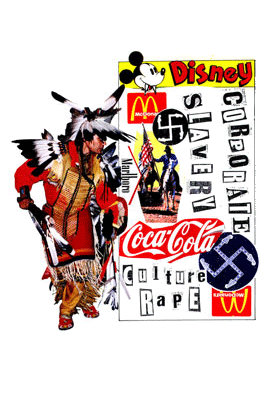
Punk was famous for its DIY visual style which combined a variety of media through a collage method. Graphics of this sort would combine photocopying with stencil work and a font mixture, referred to as ‘anonymous’ later on. Another style associated with the punk music was the ‘grunge’ – dirty, torn up graphics.


God Save the queen, one of the most iconic images of the punk culture featuring the ‘anonymous’ font.


A fine example of the DIY sense to punk was the Sniffin Glue magazine


Punk movement had equally significant visual style associated with it. As it was introduced in the mid 60s, which was a thriving period for various post-modernist graphic styles it drew inspiration from many significant visual movements.

The rich and striking colour combinations typical for the psychedelic art were present in majority of 60s works. 


To a great extent, the art of punk is associated with Jamie Reid. Reid was to graphic design exactly what punk movement was to music/society.
"Although Reid is known primarily for the deployment of Situationist strategies in his iconic work for the Sex Pistols and Suburban Press, the manifold strands of his art both continue that work whilst showing us other ways in which we can mobilise our energy and spirituality. It is this dialectic between gnosticism and dissent that lies at the heart of Reid's practice and makes him one of the great English iconoclastic artists."


Further works of Jamie Reid: